Four principles every screen had to defend
-
Role first, not feature first. The doctor’s view of a patient record and the receptionist’s view of the same appointment are different products on the same data. Every surface was designed from the role’s primary question outward.
-
Live status over manual communication. Clinical events, vitals flagged, labs collected, imaging ready, prescription dispensed, propagate to every relevant role in real time. No role has to ask another what is happening.
-
AI as augmentation, not automation. AI Scribe produces a draft the doctor edits before signing. Imaging flags show confidence, source region, and a mandatory override path. The clinical decision stays with the clinician.
-
Documentation during, not after. The consultation workspace, the telehealth session, and the imaging review all produce documentation in the same interaction. If anything has to be reconstructed from memory, the design has failed.
Problem I faced
A patient with chest discomfort walks into a clinic and triggers a chain of handoffs that no single tool in that clinic can see end to end. They book through one system. The receptionist checks them in through another. The doctor opens a third for the chart, a fourth for the ECG, a fifth for imaging. By the time the prescription reaches the pharmacy, it has passed through six or seven interfaces, none sharing a live view of the patient’s status.
US outpatient clinics run on an average of eight separate tools per day. Physicians spend two hours on administrative tasks for every hour of direct patient care, and 63% report burnout. The system is not slow because the staff are slow. It is slow because the tools were built to serve departments, not the patient journey.
AI entered the space fast: over 521 AI-enabled medical devices cleared by 2023, the majority in radiology. But integration remains unsolved. Imaging tools flag findings in separate portals and physicians copy results into notes by hand. The AI accelerates one step and adds friction to three others. The problem is not capability. It is architecture.
Solution I proposed
One patient record with five genuinely role-specific surfaces on top of it, and clinical status that propagates the moment it changes. An action taken by the health provider updates what the doctor sees without a phone call or a manual note in between. AI assists inside the surfaces clinicians already work in: transparent, editable, and overridable, with the physician’s decision recorded either way.
What the research said before any screen was drawn
What this study covered, and what it did not
In scope
-
Five role-based dashboards: Patient, Receptionist, Doctor, Health Provider, Admin
-
Patient: booking, telehealth entry, prescriptions, lab reports, billing, AI Health Assistant, records, referrals
-
Receptionist: check-in queue, appointments, insurance verification, billing support, telehealth coordination
-
Doctor: patient queue, EMR/EHR consultation workspace with AI Scribe, prescriptions, lab and imaging requests, AI insights
-
Health Provider: vitals with live monitoring triggers, lab workflow, imaging uploads, medication support, task queue
-
Admin: users and roles, departments, billing and revenue, inventory, lab operations, analytics, audit logs
-
AI Scribe: real-time transcription and SOAP note generation during consultation
-
AI Imaging: three-state finding detection with confidence, source region, and override workflow
-
Live clinical status propagation across all five roles
-
Pharmacy: fulfilment, drug interaction check, inventory monitoring, low-stock alerts
-
Design system token architecture for PHI fields, consent states, audit trail, and AI draft surfaces
Out of scope
-
Native mobile app beyond responsive web
-
Wearable and continuous monitoring device integration
-
Revenue cycle and denial management beyond billing queue visibility
-
Claims adjudication
-
Multi-clinic network and enterprise federation
-
E-prescribing to external pharmacy networks
-
Localization beyond English
Five roles, one patient journey, one system.
Each role gets the surface its first question of the day demands, built on one shared record, so an action in one role is visible in the next without a handoff.
Patient
Asks: When is my appointment, what do I prepare, what did my doctor decide?
Does: Books, joins telehealth, views prescriptions and lab reports, pays, messages the care team.
Receptionist
Asks: Who is arriving today, what is blocked, what needs me before the queue backs up?
Does: Checks in patients, verifies insurance, manages the queue, coordinates telehealth, processes referrals.
Doctor
Asks: What do I need to know before I speak to this patient, and what must I finish before the next?
Does: Reviews the pre-visit summary, consults with AI Scribe active, diagnoses, prescribes, signs the note.
Health Provider
Asks: Which patient needs me next, and what is waiting on me before the doctor can proceed?
Does: Records vitals and triggers monitoring alerts, preps procedures, coordinates labs, uploads imaging.
Admin
Asks: Is the operation running, and where is it at risk right now?
Does: Monitors operational health, manages users and roles, reviews revenue exceptions, audits compliance.
AI Scribe: the highest-stakes design problem.
When the doctor opens a consultation, the pre-visit summary is already assembled: chief complaint, vitals, ECG upload, AI cardiac risk insight, insurance profile, prior visits. They do not reconstruct context. They start from it.
As the consultation begins, AI Scribe captures the dialogue, maps content to SOAP sections, and populates the note in real time. The doctor edits inline: adding the ICD-10 code, adjusting the assessment, confirming the plan. By the time the consultation ends, the note is complete and ready to sign.
Three decisions shaped the surface. The output is always shown as a draft with an explicit Review and Sign action, never as a finished note. SOAP sections appear in order of clinical priority: Assessment and Plan first, where the high-stakes edits happen. And AI clinical insights live in the sidebar, not inside the diagnosis field: the AI surfaces evidence, the doctor’s typed diagnosis stays their judgment.
One patient record, five role-filtered views.
Role-scoped record modules would have been easier to scope, and would have rebuilt the fragmentation the platform exists to solve. One record means that when a provider flags critical vitals, the doctor sees it in the chart already open.
Consultation workspace and AI Scribe as one surface.
Most EHRs open the note editor after the visit ends. Embedding it in the consultation, populated live, is the single highest-leverage decision in the clinical surface. Post-visit documentation is the source of the 2:1 EHR time burden.
Three AI imaging states, not a binary flag.
Finding Detected, Review Recommended, No Finding, each with confidence level, scan region, model version, and an override that requires a brief clinical note. Binary flags get clicked past; medication alert overrides run 49-96%.
Live status propagation, no manual handoff.
A notification centre still needs a human to decide when to message. When vitals read 94% SpO2 and 112 bpm, that decision loop is a delay the design should not introduce. The status is always current for the role that needs to act.
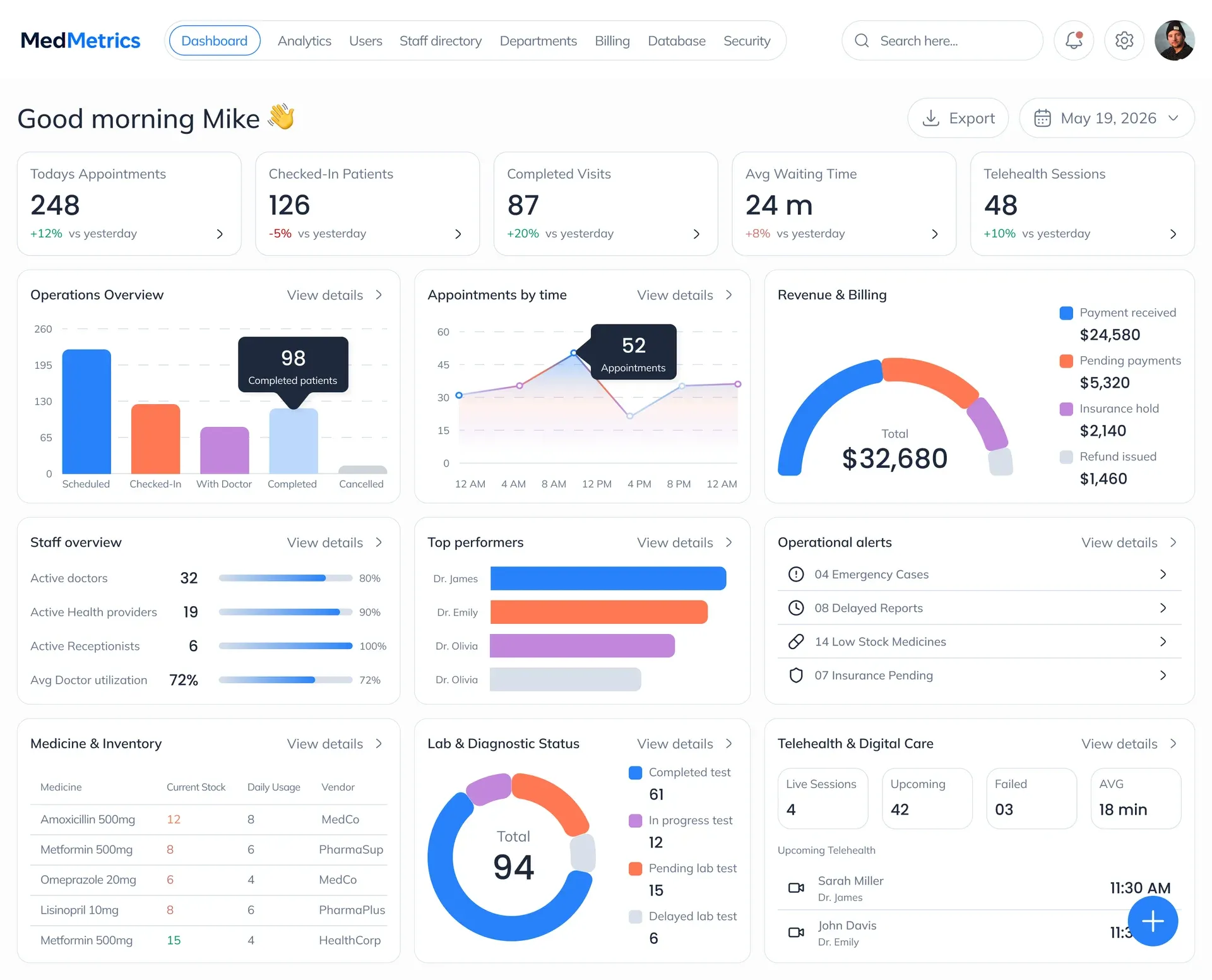
Admin dashboard as a real-time monitor, not a reporting tool.
Queue status, staff workload, inventory risk, compliance alerts, revenue flags, surfaced while they can still be fixed. A queue delay building at 10 AM should not surface in a 4 PM summary.
Token architecture for a five-role clinical platform
Three layers, primitive, semantic, component, so PHI presentation, consent states, and AI draft surfaces are never resolved to a generic status colour.
L.01 Primitive
Raw values. Never referenced directly in components.
color-clinical-red-500: #DC2626 color-clinical-amber-500: #D97706 color-clinical-green-500: #16A34A color-neutral-900: #0F172A space-4: 16px font-size-base: 14px
L.02 Semantic
Intent-based aliases. Components reference these, not primitives.
color-finding-detected color-review-recommended color-vitals-critical color-consent-required color-phi-field color-audit-trail-entry color-ai-draft-surface
L.03 Component
Scoped to specific UI patterns.
color-ai-scribe-draft-background color-ai-flag-border-high color-ai-flag-border-moderate space-consultation-panel-padding color-phi-input-background color-override-required-indicator
Every field containing Protected Health Information references one token, so a change to PHI presentation (dark mode, high contrast, audit mode) is a one-line update rather than a component-level sweep.
-
The pre-visit summary was designed from clinical workflow logic, not tested against how physicians actually read. Rapid prototype testing with practising clinicians would sharpen the section order and hierarchy. That is the next validation priority.
-
The Health Provider role carries the most complex task queue. Procedure support, the medication assistance surface, and the handoff to Pharmacy need a dedicated pass at higher fidelity.
-
Admin analytics was scoped to real-time monitoring. Historical reporting, department trends, billing forecasts, compliance exports, becomes its own project once the live layer is generating data worth analysing.
If you are hiring for a senior product designer role in healthtech and want to discuss this work or anything in my portfolio, reach me at hey@shahriarsultan.com .